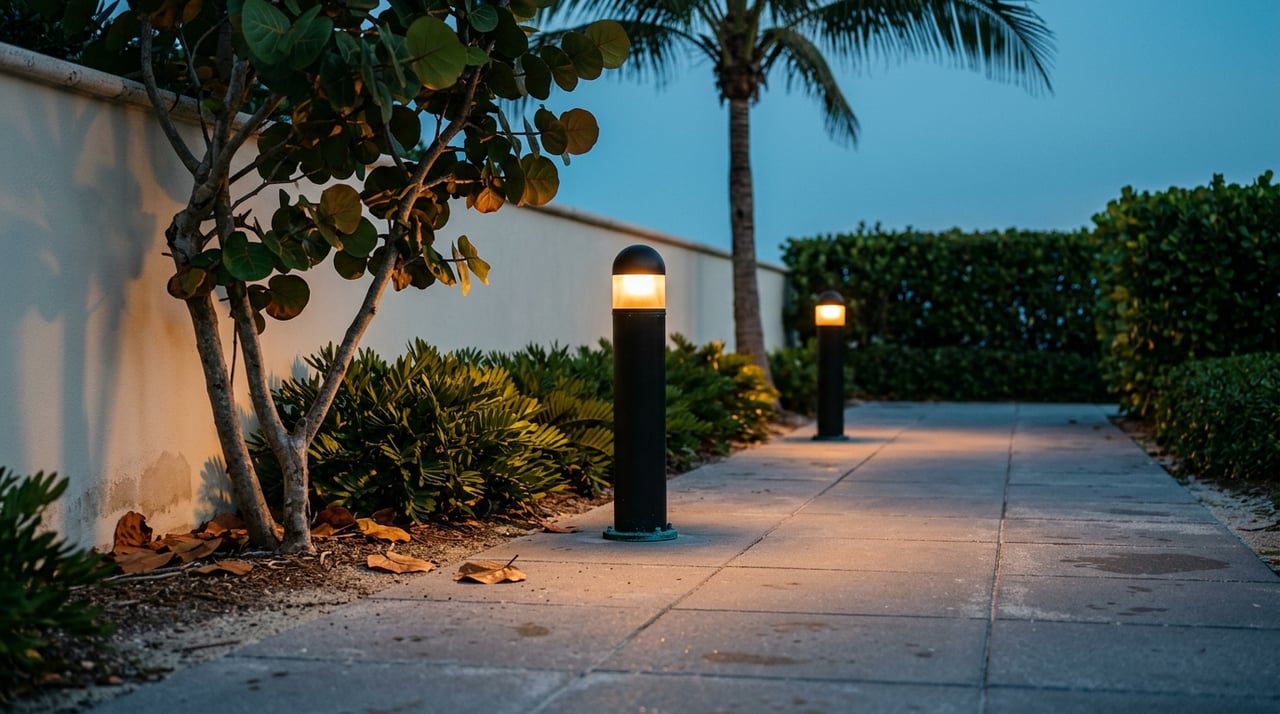
Walk A1A after dark right now and the light looks wrong before you can say why. The pedestrian fixtures along the west side of the road, the ones that have always thrown a flat white glow across the sidewalk, have shifted to a warm amber. It is a deliberate design choice shaped by the law, and the fixtures change color on a schedule most residents never think about until the color changes under their feet.
That shift is the small, visible edge of a much bigger seasonal mechanism working through Fort Lauderdale Beach right now, one that quietly reorganizes what is lit, what is loud, and what is actually happening on the sand between March and Halloween. Most of what gets written about the beach this time of year covers restaurant openings or event calendars as if they exist on their own. They do not. They sit on top of a legal calendar built around sea turtles, and that calendar does not line up with the entertainment calendar the Beach Business Improvement District built for tourist season. The gap between the two explains more about your current summer on the beach than either one does alone.
The Ordinance Behind the Color Change
Sea turtle nesting season in Fort Lauderdale runs from March through October, with leatherbacks arriving first in early spring, loggerheads following in April, and green turtles nesting through May and June. Peak nesting typically lands at the end of June or the start of July, according to the City of Fort Lauderdale's own sea turtle program. Nests take roughly two months to incubate, which puts peak hatching squarely in late summer, meaning the highest volume of hatchlings crawling toward the water is happening on your beach right now, in August.
Hatchlings navigate by light. On an undeveloped coastline, the brightest light on the horizon is the reflection of the moon and stars on open water, and that is the cue they follow. Add a lit condo tower, a string of balcony lights, or an uncovered streetlamp, and hatchlings crawl toward the building instead of the surf. The Florida Fish and Wildlife Conservation Commission lays out the fix in what it calls the three golden rules of beachfront lighting: fixtures mounted as low as possible, bulbs at the lowest wattage the job requires, and long-wavelength light only, meaning amber, orange, or red, shielded and pointed down. The same guidance recommends window tint at 45 percent transmittance or lower for glass facing the beach, with some buildings using tints as low as 15 percent.
The city does not leave compliance to chance. Every February, before nesting season opens, staff send a Sea Turtle Awareness Package to every business, hotel, and residence with a sight line to a nesting beach. According to the City of Fort Lauderdale, properties get an inspection notice with ten days to fix the problem.
A1A's Lighting Got a Redesign, Not a Repair
The amber fixtures you are noticing on your evening walk are not old lights aging into a different color. The Beach Business Improvement District recently completed a redesign of the pedestrian lighting along the west side of A1A between Alhambra Street and Sunrise Boulevard specifically to address sea turtle and beachgoer safety together, rather than treating them as competing priorities. The new LED fixtures along that stretch are built to run white light most of the year and shift automatically to amber for the length of nesting season, which means the color change you are seeing this week is the system doing exactly what it was engineered to do.
That single design decision solves a problem oceanfront buildings have wrestled with for years: how to keep a walkway safely lit without violating the same lighting code the city is actively enforcing against residents. It is the kind of infrastructure detail that never shows up in a listing description but shapes how a beachfront block actually looks and functions for eight months of the year.
The Lawn Goes Dark on a Different Schedule Than the Turtles
Here is where the mismatch shows up. Las Olas Oceanside Park, the Intracoastal Promenade, the Sunset Terrace atop the Las Olas Beach Garage, and DC Alexander Park make up what the city and the BID collectively brand as The LOOP, a $78 million public realm built into the heart of Central Beach at 3000 E. Las Olas Boulevard. It is genuinely the civic center of the neighborhood most of the year. But its two signature recurring programs run on a visitor-season calendar, not a turtle-season one.
Friday Night Sound Waves, the free concert series marking its tenth year in 2026, runs its schedule from late January into early April, with a different act announced most weeks and pre-show lawn games and vendor pop-ups before each show. Yoga on the Lawn follows a similar arc, running Saturday mornings from November through June. Both effectively go dark for the stretch of summer that overlaps almost exactly with peak sea turtle hatching. The park that was purpose-built to be the neighborhood's front lawn is at its quietest during the exact weeks the beach itself is at its most biologically active.
What does keep running is The MKT, the market at Las Olas Oceanside Park, open Saturdays from 9 a.m. to 6 p.m. and Sundays from 10 a.m. to 6 p.m., year-round, rain or heat.
Here is the current split, as of this week:
| Running through August | Paused until fall or winter |
|---|---|
| The MKT weekend market at Las Olas Oceanside Park | Friday Night Sound Waves (resumes late January) |
| Amber turtle-safe lighting enforcement citywide | Yoga on the Lawn (resumes November) |
| Dine Out Lauderdale prix fixe menus | The Sound Waves lawn games and vendor rotation tied to concert nights |
Where the Noise Actually Moved
With the park's flagship programming on hiatus, the liveliest new activity in Ocean Views this season has moved off the lawn and onto a plate. Ocean Prime opened this year as the first restaurant inside the redeveloped Las Olas Marina at 171 Las Olas Circle, a two-story, 15,000 square foot space with terrace seating on both levels, a private dining room for up to 32 guests, and dockage for anyone arriving by boat. It marks the brand's first East Coast Florida location and puts a genuine dinner destination within a five-minute walk of the sand at the foot of the Las Olas Bridge.
Closer to the water itself, Del Mar opened at Auberge Beach Residences on North Ocean Boulevard, taking over the space that spent years as DUNE by Laurent Tourondel and reworking it into a Mediterranean, coastal Southern European menu built around shared plates and seafood.
Layered on top of both is Dine Out Lauderdale, the city's annual prix fixe promotion, which runs across August and September this year and gives residents a low-friction way to try either new room without committing to a full-price tasting menu, according to Riverwalk Fort Lauderdale's event calendar.
The lawn built for visitor season went quiet right when the turtles needed it to. The dining scene, which runs on its own commercial clock, filled the gap without anyone planning it that way.
What This Means If You Already Live Here
Check your own balcony and pool lighting against the FWC's amber-and-shielded standard, and raise it with your condo association if common-area fixtures still throw white light toward the sand. Hatching is still underway through the next several weeks, so this isn't a box you check once in spring and forget.
On the lifestyle side, this is the moment to treat the Saturday market as the one constant on a calendar that has otherwise gone quiet, and to use Dine Out Lauderdale as your excuse to get into Ocean Prime or Del Mar before the discount window closes and the fall programming calendar turns the lawn back on.
None of this shows up in a listing photo, and none of it shows up if you're comparing this neighborhood from a spreadsheet in another state. It shows up when you've watched the lights change color enough summers in a row to ask why. If you're weighing what a place like this is actually worth to live in, not just to look at, that's the kind of read Team Van Zyl brings to every conversation about Fort Lauderdale Beach.
This article is general information, not legal, tax or financial advice. Consult a qualified professional about your situation.