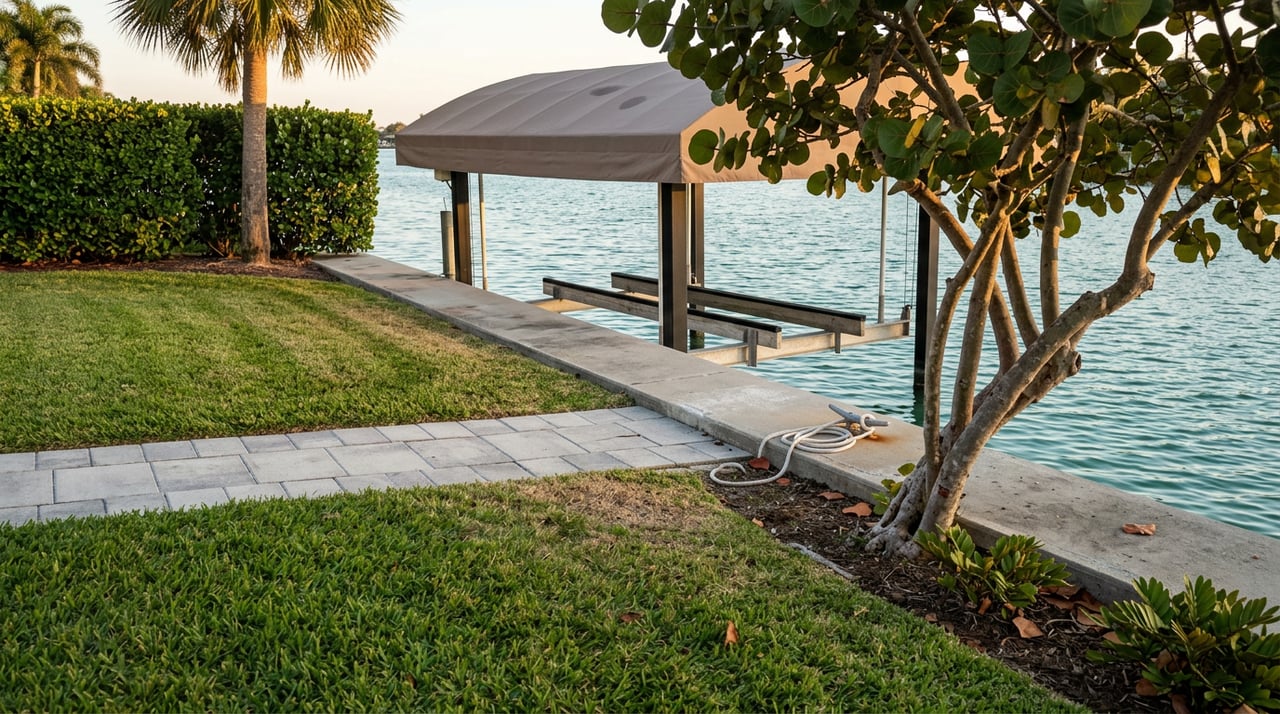
A waterfront seller in Rio Vista or Las Olas Isles calls a marine contractor about a hairline crack in the seawall cap. The contractor takes one look, measures the length of the damage against the total shoreline, and delivers unwelcome news: this isn't a repair anymore. Under Broward County's resiliency code, once the damaged section crosses 50 percent of the wall's linear length, or the fix costs more than half of what the whole barrier is worth, the project legally becomes a full replacement. That means new sheet pile, a new concrete cap, and a mandatory rise to 5.0 feet above the NAVD88 datum, whether or not anyone involved wanted to rebuild the wall from scratch.
This is the friction that actually matters for anyone buying or selling on a Fort Lauderdale canal right now, and it's the story hiding underneath a piece of good news the city announced this spring. In May 2026, Fort Lauderdale commissioners approved a Living Seawall Permit Fee Assistance Program, a $50,000 fund meant to nudge waterfront owners toward eco-friendly seawall designs by covering their permit fees, according to Waterfront Times. It's a genuinely interesting policy. It's also, once you look at the numbers behind it, a small rebate sitting on top of a much larger and much older cost problem.
The Number Behind the Program
Here's the detail that should stop any waterfront buyer or seller mid-scroll: from October 2023 to October 2025, the city issued 176 seawall permits. Only one of them was for a living seawall, according to Fort Lauderdale's chief waterways officer, Marco Aguilera. That's not a rounding error. That's a near-total absence of adoption for a technology the city, FIU researchers, and local marine permitting firms all describe as better for water quality and habitat.
Those permits predate the incentive, so they don't show how the new program will affect owners' choices. The fund is split into $25,000 for residential projects and $25,000 for commercial ones, with assistance capped at $3,500 per residential project and $7,000 per commercial project. That cap lines up almost exactly with the seawall permit base fee, which in Fort Lauderdale runs 1.75 percent of the installation cost, according to Union-Bulletin. On an average $100,000 seawall, that's a $1,750 fee. The $50,000 fund, at $1,750 a project, covers roughly 28 living seawalls before it runs out.
For scale, the fund could cover roughly 28 projects, compared with the 176 seawall permits issued in the two years before the incentive. The incentive removes one small line item, the permit fee, while construction costs and elevation and replacement rules remain separate considerations.
Why "Repair" Is the Word That Costs You $100,000
The seawall ordinance itself has been on the books since Broward County adopted its regional elevation standard in January 2020, giving cities until 2022 to fall in line and property owners until 2050 to reach compliance. Fort Lauderdale's version requires new and replaced seawalls to reach at least 5.0 feet NAVD. The county's own planning guidance frames this bluntly: individual seawall investments haven't delivered the flood protection people expect, because a single low wall next to a compliant one still lets water through, which is why the standard exists at all.
None of that is news to anyone who has owned Broward waterfront for a while. What catches people off guard is the classification trigger. A property owner who thinks they're paying for a modest cap repair can find out, mid-project, that the scope has legally become a full replacement, at four to ten times the cost.
The math scales in both directions. A single-family lot with 100 feet of canal frontage is looking at a seawall project priced somewhere between $80,000 and $200,000, depending on which contractor's linear-foot estimate you're working from, roughly $800 to $2,000 per foot. Run that same math at institutional scale and you get a sense of what full compliance actually costs a large parcel: The Church-by-the-Sea, on Fort Lauderdale's barrier island near the 17th Street Causeway, is rebuilding 980 feet of seawall, with groundbreaking expected this year and completion targeted for spring 2027. Apply the same per-foot range to that length and the project lands somewhere between roughly $780,000 and nearly $2 million. Most residential owners will never see numbers that large, but the project shows the same rule applying at every scale: length and cost thresholds, not the age of the wall, decide whether you're doing a repair or building new.
| Item | Typical figure |
|---|---|
| Seawall permit base fee | 1.75% of installation cost |
| Average seawall installation | Roughly $100,000 |
| Base permit fee at that cost | About $1,750 |
| Living Seawall incentive cap, residential | $3,500 per project |
| Total incentive fund | $50,000 ($25,000 residential / $25,000 commercial) |
| Cost per linear foot, new construction | Roughly $800 to $2,000 |
| Minimum elevation for new/replaced seawalls | 5.0 ft NAVD88 |
The Permit Cycle That Eats Three to Four Months
Even a project that clears the classification question still has to survive the permitting sequence, and this is where Broward's waterfront ownership stands apart from almost anywhere else in Florida. A single seawall or dock project can touch a county environmental license, a state Florida Department of Environmental Protection review, and a city building permit, layered on top of whatever an HOA requires. Permitting specialists working these files regularly put the full timeline at three to four months once engineering, environmental review, and local approvals run their course, and that's before weather or material delays.
A few specific failure points show up again and again in Broward's canal-front cities:
- According to Breezy Permits, HOA approval has to be secured before the city will accept the application, not alongside it. Owners who submit to the city first often get sent back to start over.
- Boat lifts usually clear the county's simpler General License, but the lift motor needs its own separate electrical permit and inspection. This is the most common reason a lift project stalls right at the finish line, with the structural side closed out while the electrical inspection is still pending.
- Some Broward canals run along land that is technically a public right of way rather than private property. If that applies to your seawall, you need a right-of-way permit in addition to the standard building permit, something many owners never learn until the application bounces back.
- Taller lifts and canopies can run into view corridor restrictions in dense canal-front cities like Fort Lauderdale and Hollywood, an extra layer that rarely shows up until a design is already drawn.
- Older, nonconforming docks in cities like Dania Beach and Deerfield Beach frequently predate current setback rules, which means a straightforward-looking replacement can require a variance most owners didn't budget time for.
None of this means the incentive program is meaningless. Fort Lauderdale is covering a real cost, and a resilient, habitat-friendly wall is a reasonable thing for a city to want more of. But for a buyer evaluating a canal-front listing, the $3,500 rebate is not the number to focus on. The classification of the last seawall project on that property, and whether it already crossed the replacement threshold, is.
What This Means If You're Buying or Selling on the Water
Before making an offer on, or listing, a Fort Lauderdale canal-front or Intracoastal property, it's worth treating the seawall the way you'd treat a roof or an HVAC system: as an asset with a known age, a known compliance status, and a known remaining life. Ask for the most recent survey and any elevation certificate referencing NAVD88. Ask whether any past repair work exceeded 50 percent of the wall's length or cost. If a project is pending or planned, build the permit timeline, three to four months at minimum, into your closing schedule or escrow terms rather than assuming the work can happen quickly after the sale.
A Few Questions Worth Asking Directly
Does raising a seawall lower flood insurance premiums? Not automatically. Flood insurance premiums are driven primarily by the building's elevation relative to FEMA's Base Flood Elevation and flood zone designation, which are evaluated separately from the seawall's top elevation.
If I'm only replacing a dock or boat lift, do I have to raise the seawall too? Not necessarily. The 5.0-foot NAVD standard applies to new seawalls and substantial seawall repairs or replacements, though each city's waterway ordinance and marine advisory board can weigh in on unusual configurations.
Is a living seawall actually cheaper to build than a standard one? The city's incentive only offsets the permit fee, not construction costs. Living seawall systems, including the 3D-printed designs used by companies like Kind Designs, are generally priced comparably to traditional concrete or vinyl construction, with the environmental benefit as the differentiator rather than a discount.
Waterfront ownership in Fort Lauderdale comes with real infrastructure behind the view, and the rules governing that infrastructure are getting more specific every year, not less. If you're weighing a purchase or preparing to list a canal-front or Intracoastal home, Team van Zyl can walk through what a property's seawall history actually means for your timeline and your offer. Get Home Value and start that conversation with real numbers in hand.
This article is general information, not legal, tax or financial advice. Consult a qualified professional about your situation.